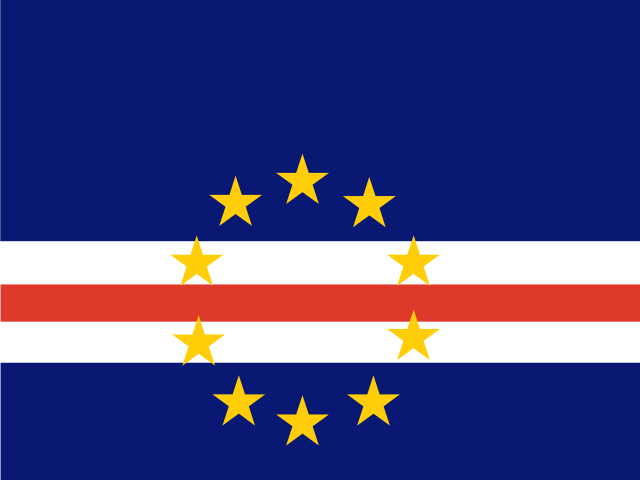
Cape Verde Islands
Next match
No upcoming match scheduled.
Historic World Cup Debut
Off the west coast of Africa, ten volcanic islands rise from the Atlantic — this is Cabo Verde, a nation of barely 600,000 people where the sea shapes everything: livelihood, identity, music, and the perpetual ache of emigration. For decades, Cabo Verdeans watched the World Cup from the outside, scattered across diaspora communities from Lisbon to Boston, supporting other nations because their own had never made it to football's biggest stage.
That changes in 2026.
This qualification was not luck. Cabo Verde quietly built one of Africa's most dangerous emerging sides — disciplined, technically sharp, fearless against larger nations. Over two years of qualifying, they ground out results against countries with populations ten and twenty times larger. Their players are forged in Portuguese and European football: fast in transition, aggressive without the ball, confident under pressure.
But this story is larger than football. Cabo Verde has one of the world's highest emigration rates relative to population. Entire generations grew up between continents, carrying identity through language, music, and sport. For the diaspora — in Rotterdam football clubs, New England neighborhoods, and Praia itself where people will stay awake through the night — seeing their flag at a World Cup is emotional proof that a small nation can still belong on the world stage.
Some teams qualify for World Cups. Cabo Verde arrived.
Players to watch
- Ryan Mendes
- Dailon Livramento
- Jovane Cabral
An Atlantic archipelago of 10 islands, Cabo Verde gained independence from Portugal in 1975. Their first-ever World Cup appearance comes 51 years later.
Group H standings
| # | Team | P | GD | Pts |
|---|---|---|---|---|
| 1 | Spain | 2 | +4 | 4 |
| 2 | Uruguay | 2 | 0 | 2 |
| 3 | Cape Verde Islands | 2 | 0 | 2 |
| 4 | Saudi Arabia | 2 | -4 | 1 |
Follow Cape Verde Islands at the World Cup
Updates coming soon.